|

Modern structured data for Clarion applications
Move beyond flat INI files with structured, readable TOML.
ProTOML gives Clarion developers a simple way to create, read, store and exchange structured TOML data from their applications.
Use ordinary Clarion fields, GROUPs, QUEUEs and FILE record buffers to build structured data that can be stored in memory, in a MEMO or BLOB, exchanged with another application, or saved as a standard `.toml` file.
Why would a Clarion developer want TOML?
Clarion makes it easy to work with structured application data inside your program. The problem comes when you need to save that structure or exchange it with something outside your application.
Traditional INI files are useful for simple settings, but applications frequently need more than a collection of flat name/value pairs.
You may need to store:
- Application and user preferences
- Groups of related settings
- Profiles and configuration data
- Lists of repeating items
- A parent record together with related detail information
- Application state that needs to be restored later
- Data that another program, service or programming language can read
- Structured information in a MEMO or BLOB without creating additional database tables
That is where ProTOML fits.
ProTOML lets you turn ordinary Clarion data into a portable, human-readable structured document, and turn that document back into Clarion data again.
Store structured Clarion data anywhere you can store the document
With ProTOML, information that normally requires multiple structures or even additional database tables can sometimes be represented as one self-contained TOML document.
For example, an application might have:
- A GROUP containing customer or application information
- A QUEUE containing a variable number of detail items
- Individual settings or values
ProTOML can combine that information into one readable structured document.
That document can then be kept in memory, stored with a record in a MEMO or BLOB, written to a `.toml` file, or passed to another part of your system.
Human-readable by design
TOML stands for Tom's Obvious Minimal Language. It was designed as a readable configuration and data format that people can understand without requiring a special editor.
Instead of creating your own delimiters, parsing routines and storage conventions, your application can use a standardized structured format.
That makes TOML useful not only for application configuration, but anywhere you want structured information that remains understandable outside your Clarion program.
Made for Clarion
ProTOML is not simply a generic TOML DLL with a Clarion prototype added to it.
The normal ProTOML interface is designed around the way Clarion developers already work.
ProTOML understands ordinary Clarion:
- STRING and numeric values
- Boolean values
- Dates and times
- GROUP structures
- QUEUE structures
- FILE RECORD buffers
Your existing structures do not have to be declared BINDABLE just to use ProTOML.
Optional Clarion `NAME` attributes can also be used when you want stable or more descriptive names in the resulting TOML document.
From Clarion...
Your application already has the data.
A customer record may be in a FILE buffer. Settings may be in a GROUP. Repeating information may be in a QUEUE.
ProTOML provides the bridge between those familiar Clarion structures and a modern structured document.
...to readable TOML
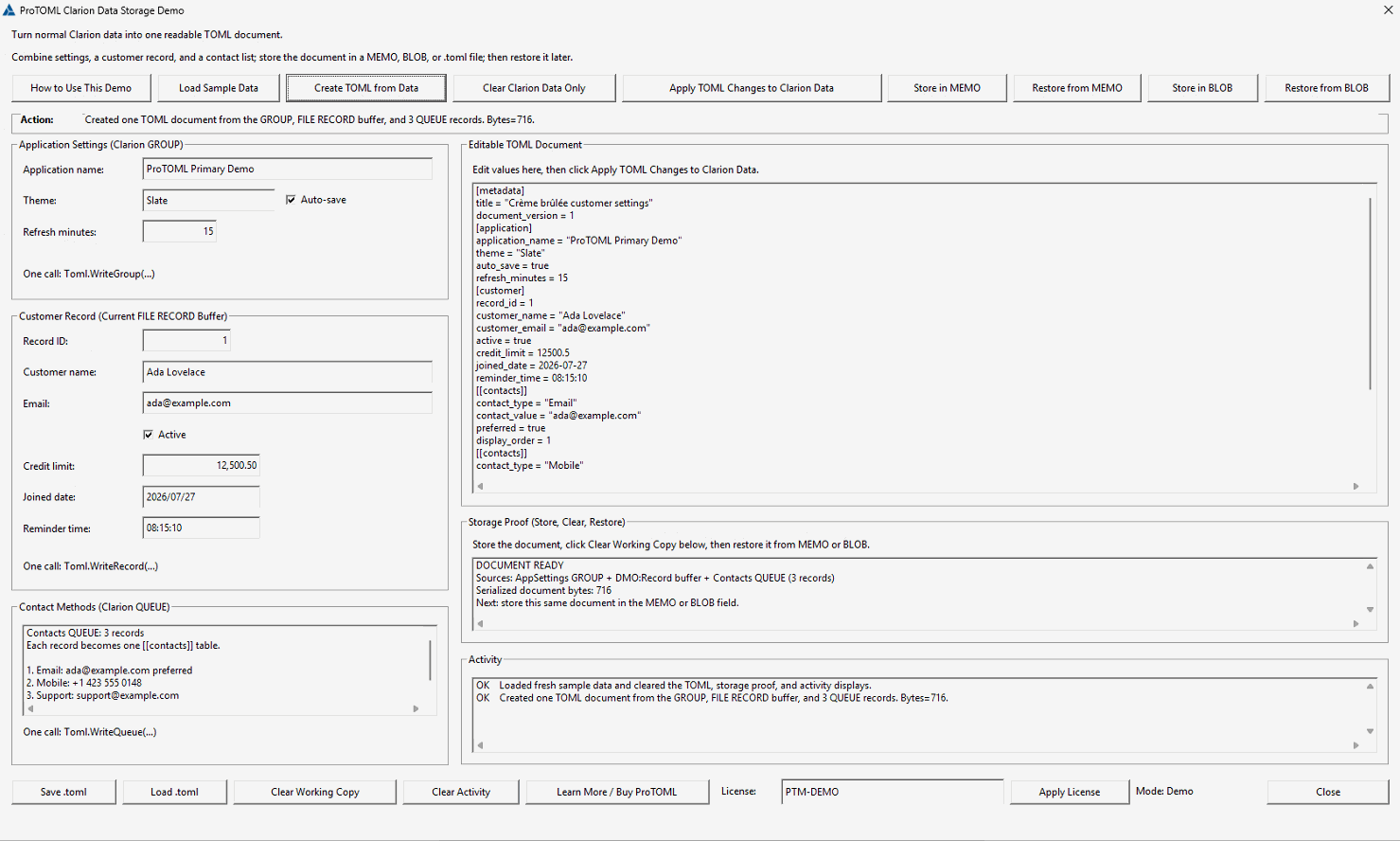
The demonstration shows real Clarion values and structures being converted to TOML and then read back into Clarion.
See exactly how Clarion data becomes readable TOML and how TOML is restored back into Clarion data.
What can you do with ProTOML?
Application Configuration
Create structured configuration files without having to force increasingly complex information into an INI file.
Save User or Application State
Collect related application settings and state into one document that can be stored and restored later.
Store Structured Data in a Record
Keep an entire collection of related information in a MEMO or BLOB when creating additional relational tables would add unnecessary complexity.
Import and Export Data
Create readable structured data that can be moved between applications or machines.
Exchange Data With Other Software
TOML is not a Clarion-specific format. Other programming languages and tools can work with the same data without having to understand Clarion's internal structures.
Package Related Information Together
Combine individual values, GROUPs and repeating QUEUE data into one self-contained document.
You don't have to write a TOML parser
Of course, you could write code to generate a text format yourself.
Then you would also have to write the parser, handle escaping and data types, reconstruct nested structures, maintain the format as your application changes, and make sure your reader and writer always agree.
ProTOML takes care of that work so you can concentrate on your application.
Easy to add to a Clarion application
The normal ProTOML interface uses the supplied Clarion template and high-level wrapper.
Add ProTOML to your application, initialize it with your developer license, and work with TOML through the Clarion interface.
Developers who need lower-level control also have access to the underlying DLL API.
Clarion Demo Program Included
The screen shot above is from the working source project demo included with the template.
It gives you an easy way to understand how ProTOML works and to see the transformation between TOML and Clarion data in a live format.
You can load sample data, create the TOML at the click of a button and see what is produced. Then you can modify it onscreen as text, click a button and see it transformed back into Clarion data.
You can also load and save Clarion data as TOML into BLOB or MEMO storage.
Since ProTOML understands GROUPS, QUEUES and RECORDS as well as regular data types using ProTOML is easy and requires just a few lines of code!
ProTOML Highlights
- Designed specifically for Clarion developers
- Create and read standard TOML
- Map ordinary Clarion GROUPs
- Map Clarion QUEUEs
- Work with FILE RECORD buffers
- No BINDABLE requirement
- Store TOML in strings, MEMOs and BLOBs
- Load and save `.toml` files
- Preserve structured and repeating information
- Human-readable output
- Suitable for configuration, storage and data exchange
- High-level Clarion interface for normal application development
- Low-level DLL API available for advanced use
Requirements
Current Version: 1.1.0
Supports:
- Clarion 12
- Clarion 11.x
- Clarion 10
- Clarion 9.x
- Clarion 8
- Clarion 7
- Clarion 6.x
- Clarion 5.5
Template Chains:
- ABC Template Chain
- Legacy Template Chain
Price
|